
What is allergy testing?
An allergy happens when your immune system treats something harmless — dust, pollen, a particular food — as a threat, and reacts to it. Allergy testing is the process of exposing your body to tiny, controlled amounts of common triggers and measuring which ones actually provoke that reaction.
It matters because allergy symptoms are frustratingly non-specific. A blocked nose in Gurugram could be dust mite allergy, seasonal pollen, construction dust, a deviated septum, or plain chronic sinusitis. They feel similar. They are treated very differently. Testing tells us which conversation we are actually having.
Allergy testing does not cure anything by itself. What it does is turn a vague problem into a specific one. Once we know you react strongly to dust mite and not to pollen, the avoidance advice becomes practical, the medication becomes targeted, and immunotherapy becomes an option worth discussing.
Signs you should get an allergy test
Most people put this off for years, treating each flare-up with whatever antihistamine the chemist recommends. Consider getting tested if any of these sound familiar:
Long-standing untreated allergy is not just uncomfortable. Persistent nasal inflammation contributes to sinusitis, nasal polyps, poor sleep, and in children, disturbed growth and concentration. Testing early is usually the cheaper path.
Types of allergy tests available
There is no single "full allergy test" that covers everything — different methods suit different situations. At the clinic we work with the following.
| Test | How it works | Best suited for | Results |
|---|---|---|---|
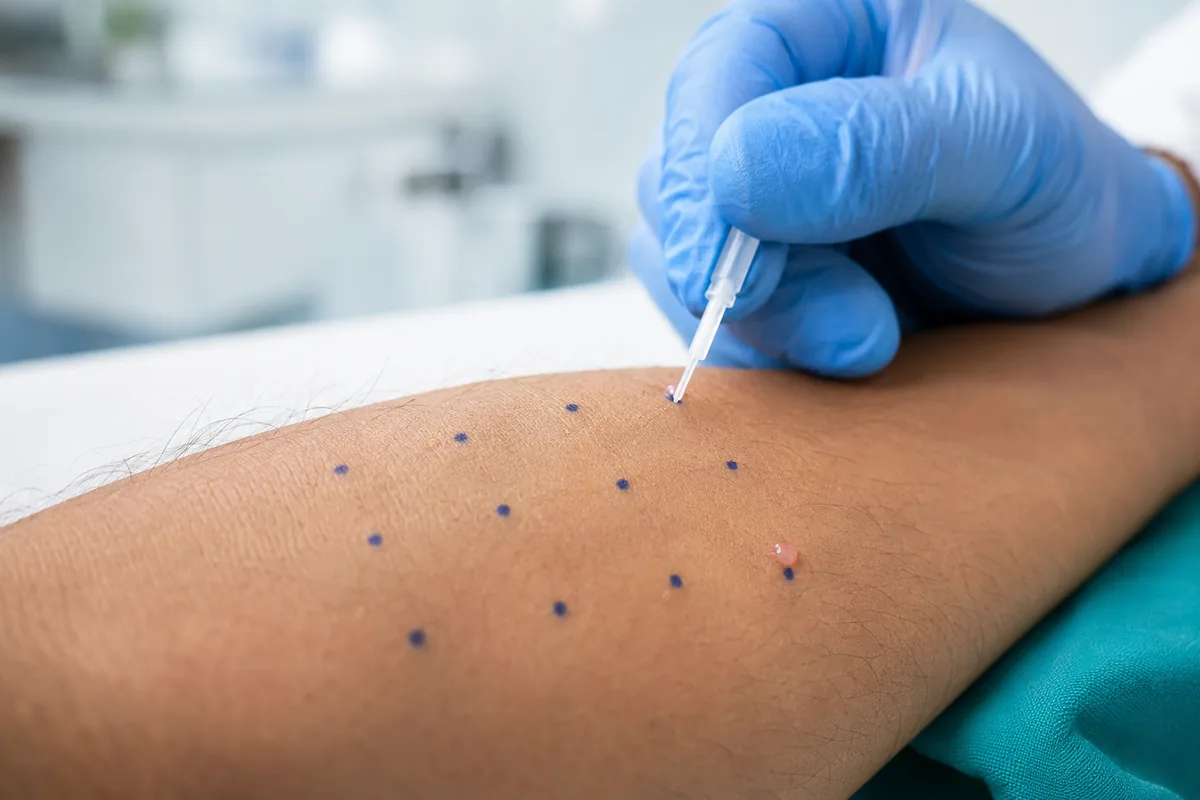
| Skin prick test (scratch test) | A drop of allergen extract is placed on the forearm and the skin is gently pricked through it | Airborne allergens — dust mite, pollen, mould, pet dander | About 20 minutes |
| Allergy panel blood test (specific IgE / RAST) | A single blood sample is screened against a panel of allergens in the lab | Patients on antihistamines, with eczema, or with severe reactions | 2–4 days |
| Intradermal test | A very small amount of allergen is injected just under the skin | Selected cases where the prick test was inconclusive | About 20 minutes |
| Nasal endoscopy | A thin camera examines the nasal lining directly | Confirming allergic inflammation, polyps or a deviated septum | Same visit |
You may see the blood test referred to as a RAST test, a RAST assay, an allergy panel test or a specific IgE test. These names all describe the same broad idea: measuring allergy antibodies in the blood rather than reading a reaction on the skin. Modern laboratories mostly use newer methods than the original RAST technique, but the term has stuck in everyday use.
The skin prick test, step by step
This is the test most people mean when they search for a skin allergy test. It is quick, done sitting in a chair, and far less unpleasant than the name "scratch test" suggests.
- Preparation. You will be asked to stop antihistamines for about 5–7 days beforehand, since they suppress the very reaction we are trying to see. Most other medicines can continue — tell us what you take.
- Marking. The inner forearm is cleaned and marked in a grid, one square per allergen, plus two controls that tell us the test is behaving correctly.
- Application. A drop of each allergen extract is placed on its square and a fine lancet gently pricks the surface of the skin. It is a light scratch, not an injection. Children usually tolerate it well.
- Waiting. You sit for about 15–20 minutes. Where you are allergic, a small itchy bump like a mosquito bite appears.
- Measuring. Each bump is measured and compared against the controls, then the grid is cleaned off.
The itching settles within an hour or two. You can drive yourself home and return to work the same day.
Allergy panel and RAST blood test
Sometimes the skin route is not the right one. A blood-based allergy panel test is preferred when you cannot stop antihistamines, when eczema or widespread rash leaves no clear patch of skin to test on, when there is a history of a severe reaction, or when a young child would find the skin test distressing.
It requires one ordinary blood draw. The laboratory screens the sample against a defined panel — commonly a regional inhalant panel covering house dust mite, cockroach, several pollens and moulds, and a food panel where the history suggests it. Results come back graded by class or by concentration, which we then read alongside your symptoms.
A positive result on paper does not automatically mean that allergen is causing your symptoms. Plenty of people show sensitisation to things that never trouble them in daily life. This is exactly why the report needs interpreting by a clinician who has also examined your nose — not read off a lab printout alone.
Understanding your allergy test results
You will be walked through the report in the same visit, in plain language. Broadly, results tell us three things:
- What you react to — the specific allergens, not a vague "you have dust allergy".
- How strongly — graded, which matters when deciding between avoidance, medication and immunotherapy.
- What is not the problem — genuinely useful. Ruling out a food allergy stops an unnecessary and often nutritionally poor elimination diet.
It is also worth knowing the difference between an allergy and an intolerance. True allergy involves the immune system and can be measured by these tests. Food intolerance — lactose, for instance — is a digestive process and will not appear on an allergy panel, whatever a commercial intolerance test may claim.
What happens after testing — the treatment plan
Testing is only step one. The result feeds directly into a plan built around three levers:
- Targeted avoidance. Specific, practical measures — mattress and pillow covers and hot-water washing for dust mite; different advice entirely for a pollen or mould reaction. Generic "keep the house clean" advice helps nobody.
- Medication. Usually an intranasal steroid spray with or without an antihistamine, used correctly. Spray technique is taught in the room, because most people use it wrongly and conclude it does not work.
- Immunotherapy. For confirmed, strongly positive, persistent allergy, gradually retraining the immune system to tolerate the trigger. This is the only approach that changes the underlying allergy rather than managing symptoms. Read more on allergy treatment and immunotherapy.
Where testing reveals that allergy is only part of the story — a badly deviated septum or established nasal polyps alongside it — we will say so, and discuss sinus treatment or septoplasty as part of the same plan.
Allergy testing for children
Children can be tested, and often should be. A child who mouth-breathes, snores, wakes unrefreshed or has a nose blocked for months is not simply "prone to colds" — and repeated courses of antibiotics for what is actually allergic inflammation help nobody.
For younger or anxious children we frequently prefer the blood panel, since it needs one needle rather than sustained stillness. Where the history points to enlarged adenoids as well, nasal endoscopy in the same visit gives the full picture — see tonsil and adenoid treatment.
Why have your allergy test done at Vista ENT
Plenty of laboratories in Gurugram will sell you an allergy panel. Fewer will examine your nose first and interpret the result against what they actually saw.
- Examined and tested in one place. Nasal endoscopy, testing and the treatment plan happen in the same consultation, with Dr. Harsh Vardhan performing the examination himself.
- An ENT surgeon reading the report. With over 2,000 ENT operations performed, the assessment covers the structural causes a lab report cannot see — septum, turbinates, polyps.
- Treatment does not stop at a prescription. Immunotherapy, spray technique and, where genuinely needed, surgery are all available under one roof.
- Convenient for New Gurugram. The clinic is in Vatika Town Square, Sector 82A — about 2.7 km from Kherki Daula and 7 km from IMT Manesar, with easy access from Sectors 83–89, Sohna Road, Badshahpur and the Dwarka Expressway.
If you have been searching for allergy testing near me and putting it off, a single appointment is usually enough to know what you are dealing with.