
What tympanoplasty is
The eardrum is a thin membrane that vibrates when sound reaches it and passes that vibration to the small bones of the middle ear. A perforation — a hole — interrupts that, and also removes the barrier that normally protects the middle ear from water and bacteria.
Tympanoplasty repairs the perforation using a graft of the patient's own tissue, most commonly temporalis fascia (the covering of the muscle above the ear) or cartilage taken from the ear itself. Where the middle ear bones are also damaged, they can be reconstructed at the same time — an ossiculoplasty.
Who needs eardrum repair
Many small perforations from a recent infection or injury heal by themselves within a few weeks. Surgery is considered once it is clear the hole is permanent, or where discharge and hearing loss are causing ongoing problems.
Cholesteatoma — why this one cannot wait
It is a growth of skin in the wrong place — behind the eardrum, in the middle ear. It expands slowly and erodes whatever it touches: the hearing bones first, and potentially the bone overlying the facial nerve, the balance organ and, uncommonly, the covering of the brain. It does not respond to antibiotics or drops, and it does not resolve on its own. Surgery is the only treatment.
Suspect it where there is long-standing foul-smelling ear discharge, progressive hearing loss on one side, or a persistent hole at the top edge of the eardrum. Surgery here is mastoid surgery combined with tympanoplasty, removing the disease from the mastoid bone and middle ear before reconstructing. Complete removal takes priority over hearing improvement in this situation, and long-term follow-up is essential because recurrence is possible.
How the operation is done
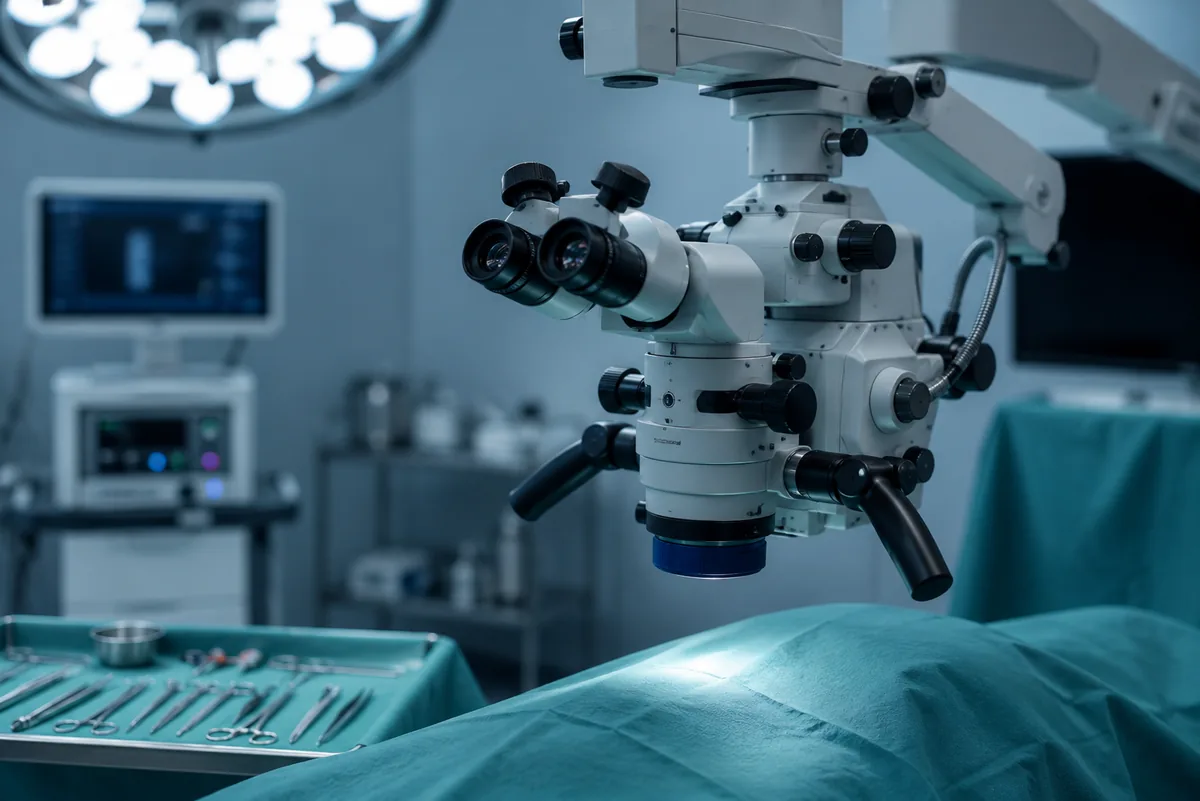
Ear surgery is performed under an operating microscope, or endoscopically, under general anaesthesia. Approach depends on the perforation's size and position:
- Endoscopic (through the ear canal). Suitable for many perforations, with no external incision at all.
- Endaural. A small incision at the front of the ear canal entrance.
- Postauricular. An incision in the crease behind the ear, giving the widest access — used for large perforations, and required for mastoid surgery. The scar sits hidden in the natural crease.
The edges of the perforation are freshened, the graft is positioned to support the healing drum, and the ear canal is lightly packed. Typical duration is one to two hours, usually with an overnight stay.
Recovery and aftercare
- First week. A dressing or head bandage for the first day or two. Some discomfort and a blocked, muffled sensation from packing in the canal. Hearing will not improve yet.
- Weeks 2–3. Packing removed at the clinic in stages. Any external stitches come out around day seven.
- Weeks 3–6. Back to normal daily activity and desk work. Avoid heavy lifting, straining and nose-blowing, all of which push air up into the middle ear and can displace the graft.
- Months 2–3. The graft integrates and hearing improvement becomes apparent. This is when the true result is assessed.
Keep the ear completely dry until cleared. Use a cotton ball with petroleum jelly when showering, and no swimming or head-dunking for at least six to eight weeks. This one instruction does more to protect the outcome than anything else.
Results you can realistically expect
Tympanoplasty for a straightforward perforation has a good success rate in closing the hole in experienced hands. The two benefits patients notice most are a permanently dry ear — no more discharge with every cold or shower — and improved hearing.
Hearing improvement is real but proportionate: it recovers the conductive loss caused by the perforation. If there is also sensorineural (inner ear) hearing loss, that component is unchanged by the operation, because the inner ear is not what was repaired. Where the hearing bones were eroded, results depend on how successfully they can be reconstructed.
Risks include graft failure requiring revision, taste disturbance on one side of the tongue from a nerve running through the middle ear (usually temporary), tinnitus, dizziness in the early days, and rarely, worsening of hearing. Facial nerve injury is very rare in routine tympanoplasty.
Consultation and otoendoscopy at Sector 82A; surgery at Fortis Hospital, Manesar. Related: ear and hearing care and hearing aids.