
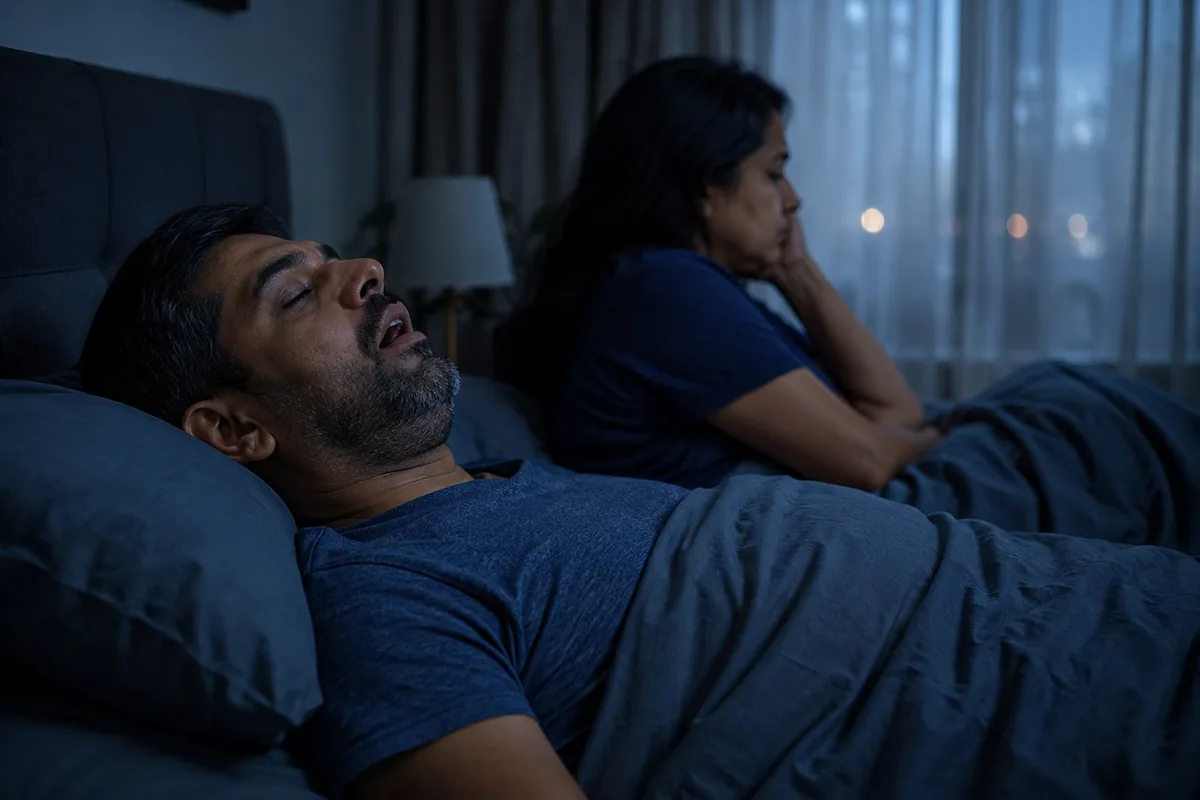
Snoring versus sleep apnea
Simple snoring is noise. Tissues in the upper airway vibrate as air passes a partially narrowed passage. It disturbs the person beside you far more than it disturbs you.
Obstructive sleep apnea (OSA) is different in kind, not just degree. The airway repeatedly collapses shut during sleep, breathing stops for seconds at a time, oxygen drops, and the brain briefly rouses you to reopen the airway. This can happen dozens of times an hour, every hour, without you remembering a single one.
The result is sleep that looks like eight hours but restores almost nothing.
Warning signs worth taking seriously
A partner's account is often the most valuable piece of information available, since the person affected genuinely does not experience the events. Bring them to the appointment if you can.
Why untreated sleep apnea matters
This is not a lifestyle inconvenience. Untreated moderate to severe OSA is associated with high blood pressure that resists medication, increased cardiovascular and stroke risk, poorer diabetes control, and a substantially raised risk of road traffic accidents from microsleeps.
If your blood pressure is difficult to control despite multiple medications — particularly if you also snore heavily — untreated sleep apnea is a recognised and frequently overlooked contributor. Treating the apnea sometimes improves blood pressure control where adding another tablet did not.
Finding where the airway is obstructing
The upper airway can narrow at several levels, and effective treatment depends entirely on identifying which one:
- Nose — deviated septum, enlarged turbinates, polyps or allergic swelling. Nasal blockage forces mouth breathing, which worsens collapse further down.
- Soft palate and uvula — a long or floppy palate is a classic vibration source.
- Tonsils — enlarged tonsils physically narrow the throat. This is the leading cause in children.
- Tongue base — the tongue falling backwards during sleep, more pronounced when lying on the back.
- General factors — weight, alcohol before bed, sedatives, and sleeping position.
Surgery aimed at the wrong level does not work. This is the single most common reason snoring operations disappoint.
Snoring in children is not normal
Regular loud snoring in a child deserves assessment. The usual cause is enlarged tonsils and adenoids, and the consequences differ from adults — children with sleep-disordered breathing more often present with hyperactivity, poor concentration and behavioural difficulty than with sleepiness.
Persistent mouth breathing, restless sleep with unusual positions, bed-wetting that restarts, and poor school performance are all worth mentioning. Treating enlarged tonsils and adenoids frequently produces a striking improvement in sleep, behaviour and growth. See tonsillectomy and adenoidectomy.
How snoring and apnea are assessed
- History and partner report, with a sleepiness questionnaire to gauge daytime impact.
- Nasal endoscopy to examine the nose, palate, tonsils and tongue base directly and identify the obstruction level.
- Sleep study (polysomnography), which measures breathing pauses, oxygen levels and sleep quality. This is what confirms apnea and grades its severity — the difference between simple snoring and OSA cannot be made by examination alone.
Treatment options
Conservative measures come first and are genuinely effective for mild cases: weight reduction where relevant, avoiding alcohol and sedatives in the evening, and side-sleeping. Weight loss has a larger effect on OSA than most people expect.
CPAP remains the most effective treatment for moderate to severe OSA. A mask delivers gently pressurised air that splints the airway open. It is highly effective when tolerated, and treating nasal blockage often makes the difference between a patient abandoning CPAP and using it successfully.
Oral appliances — custom devices holding the lower jaw forward — suit mild to moderate cases and patients who cannot tolerate CPAP.
Surgery is directed at the level identified: septoplasty and turbinate reduction to open the nose, palatal surgery for palatal collapse, and tonsillectomy where large tonsils are the obstruction — the treatment of choice in most children.
Assessment takes place at the Sector 82A clinic; surgical procedures are performed at Fortis Hospital, Manesar.