
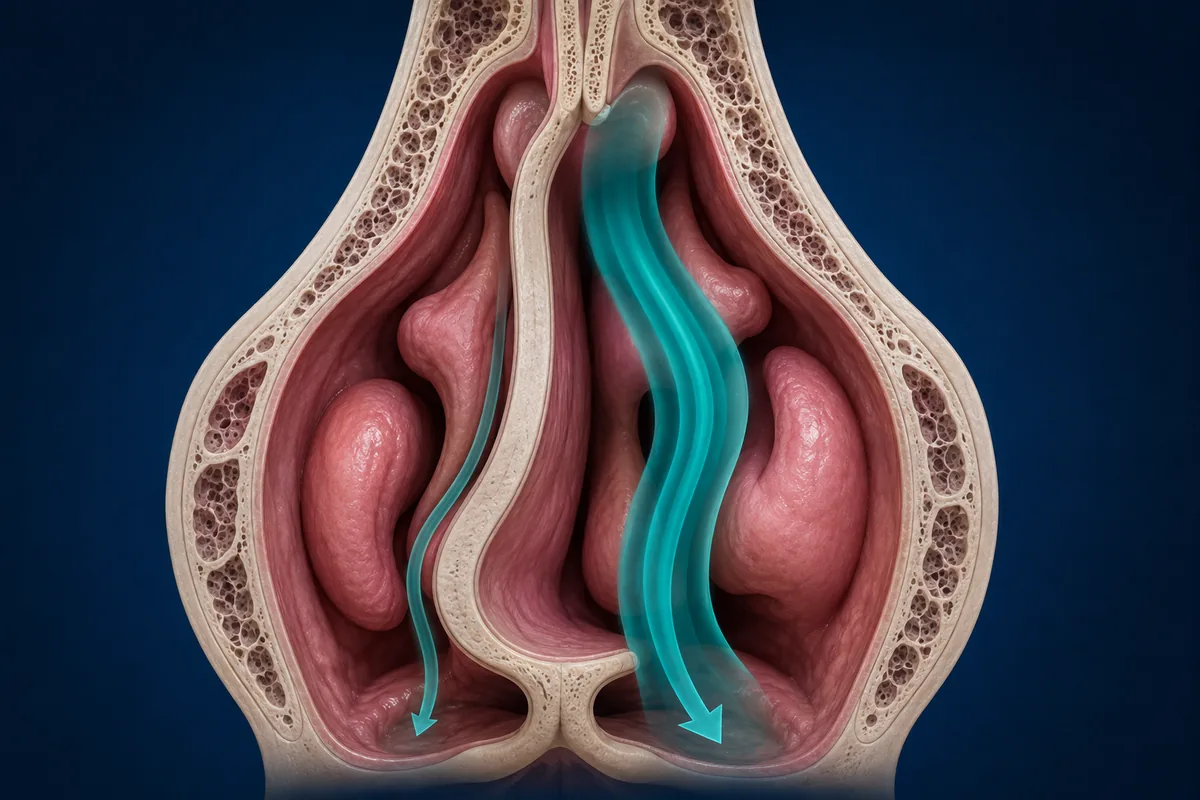
What septoplasty is
The nasal septum is the wall of cartilage and bone dividing your nose into two passages. In a large proportion of people it is not perfectly straight, and most never notice. Septoplasty is the operation that straightens it when the deviation is significant enough to block airflow.
It is a functional operation performed inside the nose. It is not rhinoplasty and does not alter the external shape of your nose — a distinction worth being clear about, since the two are frequently confused.
Who needs a septoplasty
Medical treatment is tried properly first. A deviated septum found incidentally on a scan, in someone breathing comfortably, does not need surgery.
Endoscopic sinus surgery (FESS)
Your sinuses are air-filled spaces that drain into the nose through narrow openings. In chronic sinusitis those openings become blocked by inflammation or polyps, mucus stagnates, and the cycle sustains itself.
Functional endoscopic sinus surgery uses an endoscope passed through the nostril to open those natural drainage pathways. The word functional is the key: the aim is to restore normal ventilation and drainage, not to strip out the sinuses. Preserving healthy lining is central to a good outcome.
It is considered when maximal medical treatment has genuinely been tried, when polyps are extensive, or when complications develop. It is frequently combined with septoplasty in the same sitting, since a deviated septum often physically blocks access to the sinuses anyway.
Turbinate reduction
Turbinates are ridged structures on the side wall of the nose that warm and humidify air. In chronic allergy they become permanently enlarged and contribute substantially to blockage.
Where they remain enlarged despite medical treatment, they can be reduced — usually by radiofrequency or submucosal techniques that shrink the tissue while preserving the surface lining and its function. Turbinates are deliberately reduced, never removed entirely, because excessive removal causes a distressing and largely irreversible condition known as empty nose syndrome.
What happens on the day
- Anaesthesia. General anaesthesia in most cases. You will be asked not to eat or drink for several hours beforehand.
- The operation. Everything is performed through the nostrils. For septoplasty, an incision inside the nose lifts the lining, the deviated cartilage and bone are straightened or trimmed, and the lining is replaced. Typical duration is 45 to 90 minutes.
- Packing or splints. Thin silicone splints are often placed for around a week to support the septum. Modern practice uses far less packing than in the past, which has made recovery considerably more comfortable.
- Discharge. Usually the same day or after one night.
Recovery
- Days 1–3. The nose feels blocked from internal swelling — this is expected and is not a sign the surgery failed. Light blood-stained discharge is normal. Sleep propped up.
- Around day 7. Splints removed at the clinic. Most patients notice a clear improvement in airflow within a day or two of this.
- Weeks 2–3. Back to desk work usually within one to two weeks. Saline irrigation is important during this phase to clear crusting.
- Weeks 4–6. Avoid heavy lifting, strenuous exercise, swimming and contact sport. Do not blow your nose forcefully in the early weeks.
- Months 2–3. Swelling fully settles and the final result becomes apparent.
Almost every patient worries in the first week that the operation has not worked, because the nose feels more blocked than before. That is post-operative swelling and crusting, not a failed procedure. Judge the result after the splints are out and swelling settles — not on day three.
Risks and realistic expectations
Septoplasty is a common and generally safe operation, but you should know the possibilities: bleeding in the early period; infection, which is uncommon; a small persistent hole in the septum (septal perforation); temporary numbness of the upper front teeth from nerve stretching, which usually resolves; residual deviation, since a severely bent septum cannot always be made perfectly straight; and rarely, a change in the external shape of the nose.
Realistic expectation matters. Septoplasty reliably improves structural blockage. It does not cure allergy. If allergic rhinitis is also present, it needs continued treatment after surgery — see allergy treatment. Patients who understand this before surgery are consistently the most satisfied afterwards.
Consultation and endoscopy at Sector 82A; surgery at Fortis Hospital, Manesar. Related: sinus treatment and snoring and sleep apnea.