
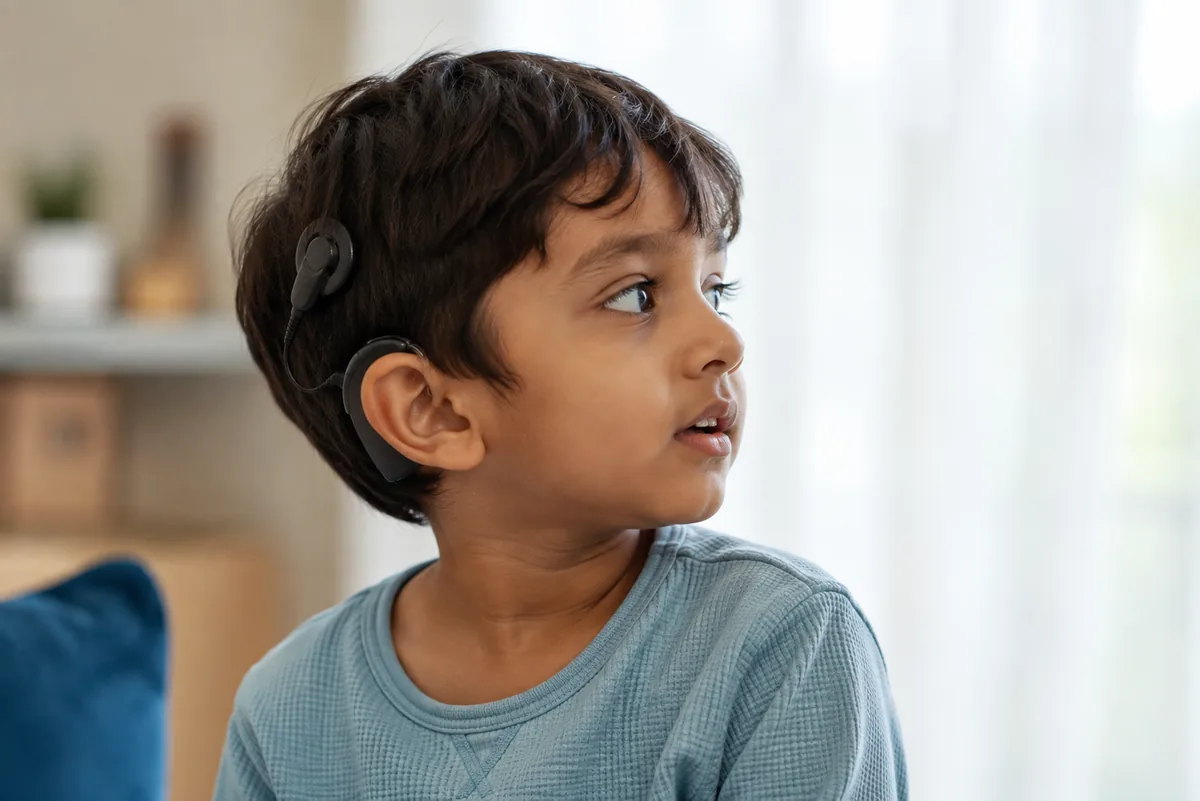
How a cochlear implant works
A hearing aid makes sound louder and delivers it through the normal pathway. That only works while enough functioning hair cells remain in the cochlea. In severe to profound sensorineural hearing loss, too few remain, and turning the volume up produces distortion rather than clarity.
A cochlear implant works differently. It has two parts:
- An external processor worn behind the ear, which captures sound and converts it into a digital signal.
- An internal implant placed surgically under the skin, with a fine electrode array inserted into the cochlea. It receives the signal across the skin and stimulates the hearing nerve fibres directly.
The damaged hair cells are bypassed altogether. The brain receives signals through the hearing nerve and, with training, learns to interpret them as sound and speech.
Who is a candidate
The last two are not formalities. An implant is the beginning of a process, not a switch that restores hearing on the day. Families who understand that consistently do better.
Why timing matters so much in children
The auditory pathways in a child's brain develop most readily in the first few years of life, and that development depends on receiving sound. A child implanted early — commonly within the first two years where hearing loss is confirmed — has a substantially better chance of developing spoken language close to that of hearing peers. Outcomes remain worthwhile later, but the advantage of early implantation is well established.
This is why newborn hearing screening matters, and why a child not responding to sound or showing delayed speech should be assessed promptly rather than watched. Congenital hearing loss identified late costs developmental time that is difficult to recover.
The assessment process
Cochlear implantation is a team decision, not a single consultation:
- Full audiological testing — pure tone and speech audiometry, plus objective tests such as ABR and OAE in young children who cannot respond reliably.
- An adequate hearing aid trial with properly fitted, optimally programmed devices. Benefit must be demonstrably insufficient.
- Imaging — CT and MRI to assess cochlear anatomy, confirm the hearing nerve is present, and identify anything that would complicate electrode insertion.
- Medical assessment for anaesthetic fitness, with vaccination status reviewed beforehand.
- Speech and language assessment to establish a baseline and plan rehabilitation.
- Counselling with the patient and family about the realistic outcome and the work involved afterwards.
The surgery
The operation is performed under general anaesthesia and typically takes two to three hours. An incision behind the ear gives access to the mastoid bone. A recess is drilled to seat the implant securely, a pathway is opened to the middle ear, and the electrode array is carefully inserted into the cochlea.
Facial nerve monitoring is used throughout, since the nerve runs close to the surgical route. Electrode function is tested on the table before closing. Most patients stay one to two nights.
The implant is not activated at surgery. Several weeks are allowed for healing and for swelling to settle before switch-on.
Switch-on and rehabilitation
Switch-on takes place roughly three to four weeks after surgery. The external processor is fitted and each electrode is programmed to a comfortable level. This programme, called a MAP, is adjusted repeatedly over the following months as the user adapts.
Initial impressions vary widely. Some people describe beeping, robotic or mechanical sound rather than natural speech. This is normal and expected. The brain is receiving an unfamiliar type of signal and must learn to interpret it.
What follows is auditory rehabilitation — structured listening practice and speech therapy, intensive at first and continuing for months. Adults who lost hearing later in life, and who already have language, generally adapt faster. Children born deaf need a longer, more sustained programme. Speech therapy is available at the clinic as part of this pathway.
Realistic expectations
Outcomes vary and depend heavily on how long the hearing loss was present, age at implantation, whether language developed before the loss, and commitment to rehabilitation.
Many adults with post-lingual hearing loss achieve good open-set speech understanding and can use the telephone. Children implanted early frequently develop spoken language and attend mainstream school. Results are less predictable in long-standing congenital deafness implanted in adulthood, where the auditory pathways never developed.
Practical points worth knowing: the external processor is removed for sleeping, swimming needs a waterproof accessory, MRI compatibility depends on the device model, and the internal implant is designed to last for decades while the external processor is upgraded periodically.
Assessment and audiology at the Sector 82A clinic; implantation performed at Fortis Hospital, Manesar. Related: hearing aids and ear and hearing care.