
Throat and voice conditions treated
Hoarseness — and the three week rule
A hoarse voice after a cold or a loud evening is ordinary and settles. A voice change that persists is not, and there is a widely used clinical threshold worth knowing:
This is not intended to alarm. The overwhelming majority of persistent hoarseness turns out to be benign — nodules, reflux, muscle tension or a polyp. But laryngeal cancer is highly treatable when caught early and much harder to treat late, and hoarseness is often its only early symptom. The examination takes minutes.
Common causes include vocal cord nodules from voice overuse (teachers, sales professionals, singers), polyps and cysts, reflux irritation, muscle tension dysphonia, and vocal cord paralysis. Smoking substantially raises the risk of more serious causes.
Tonsil problems
Tonsils are part of the immune system and most children's tonsillitis needs no surgery. Removal is considered when episodes are frequent and genuinely disruptive — the usual benchmark being around seven significant episodes in a year, five a year over two years, or three a year over three years.
Other reasons include tonsils large enough to obstruct breathing during sleep, a previous quinsy (abscess beside the tonsil), or persistent tonsil stones causing bad breath. Modern coblation tonsillectomy uses lower-temperature energy, which generally means less post-operative pain than traditional techniques.
Throat reflux — the cause people rarely suspect
Laryngopharyngeal reflux is stomach acid reaching the throat and larynx. Crucially, it often causes no heartburn at all, which is why it goes unrecognised for years.
Typical symptoms are morning hoarseness, constant throat clearing, a sensation of mucus at the back of the throat, mild chronic cough and a lump-in-throat feeling. On laryngoscopy the tissue around the vocal cords looks red and swollen in a recognisable pattern.
Treatment combines dietary and lifestyle change — avoiding late meals, raising the head of the bed, reducing caffeine, alcohol, very spicy and fatty food — with acid-suppressing medication for a defined period. Lifestyle measures matter as much as the tablets here.
The feeling of a lump in the throat
Globus — a persistent sensation of something in the throat with no actual obstruction, usually more noticeable when swallowing saliva than food — is common and usually benign. Reflux, post-nasal drip and muscle tension are the usual drivers.
The important distinction is between that sensation and genuine difficulty swallowing. Food actually sticking, pain on swallowing, or unintended weight loss are different symptoms entirely and need prompt examination.
Video laryngoscopy — seeing the vocal cords
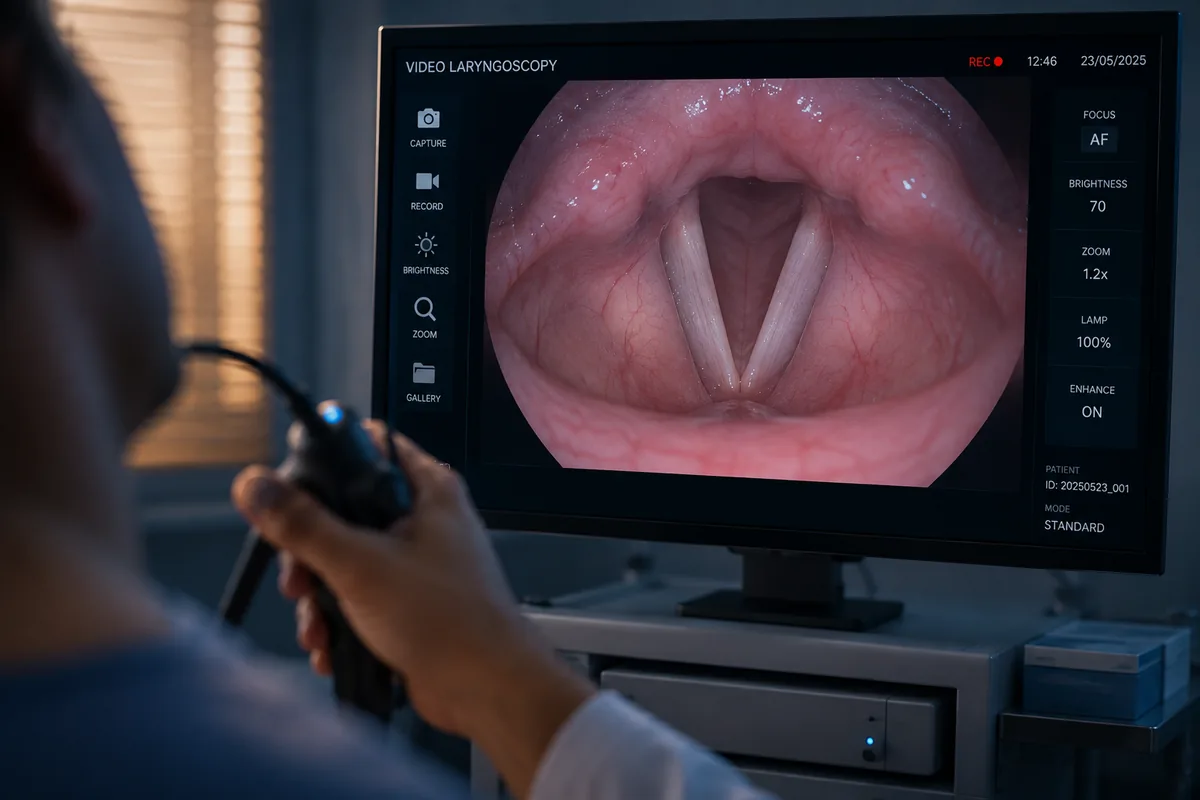
The vocal cords cannot be assessed by looking in the mouth with a torch. The clinic uses video laryngoscopy and fibre-optic nasopharyngolaryngoscopy with Olympus equipment: a slim scope passed through the nose after anaesthetic spray, giving a clear recorded view of the larynx while you speak.
It is quick and better tolerated than most people expect, and it shows the cords moving — which matters, because a cord that looks normal but moves poorly points to a completely different problem.
Voice surgery and therapy
Not every vocal cord lesion needs an operation. Nodules in particular often improve substantially with speech therapy and voice hygiene alone, and surgery on a professional voice is never taken lightly.
Phonosurgery — microsurgery on the vocal cords — is used for polyps, cysts and nodules that have not responded to conservative treatment. It is precise work aimed at restoring the delicate vibrating layer of the cord. Speech therapy is available at the clinic and is frequently combined with surgery rather than replaced by it.
Symptoms that should be reviewed promptly
- Hoarseness persisting beyond three weeks, particularly in smokers
- Difficulty swallowing, or food genuinely sticking
- Pain on swallowing that is one-sided and persistent
- A lump in the neck lasting more than three weeks
- Coughing blood, or blood-stained saliva
- Unexplained weight loss alongside throat symptoms
- Persistent ear pain with a normal-looking ear (referred pain)
Any of these warrant examination rather than watchful waiting. Where assessment raises concern, further investigation and head and neck surgical care are arranged.