
Signs you may need a hearing aid
The last one matters most. Untreated hearing loss is consistently associated with social withdrawal, low mood and accelerated cognitive decline in older adults. Addressing it is not vanity.
The hearing test, explained
A full audiological assessment at the clinic includes:
- Otoendoscopy — examining the ear canal and eardrum first, because wax or a perforation changes everything that follows.
- Pure tone audiometry — the familiar test in a quiet booth with headphones, mapping the softest sound you can hear at each frequency. This produces the audiogram.
- Speech audiometry — measuring how clearly you understand words, not merely whether you detect them. Two people with identical audiograms can have very different clarity.
- Tympanometry — measuring eardrum movement and detecting middle ear fluid.
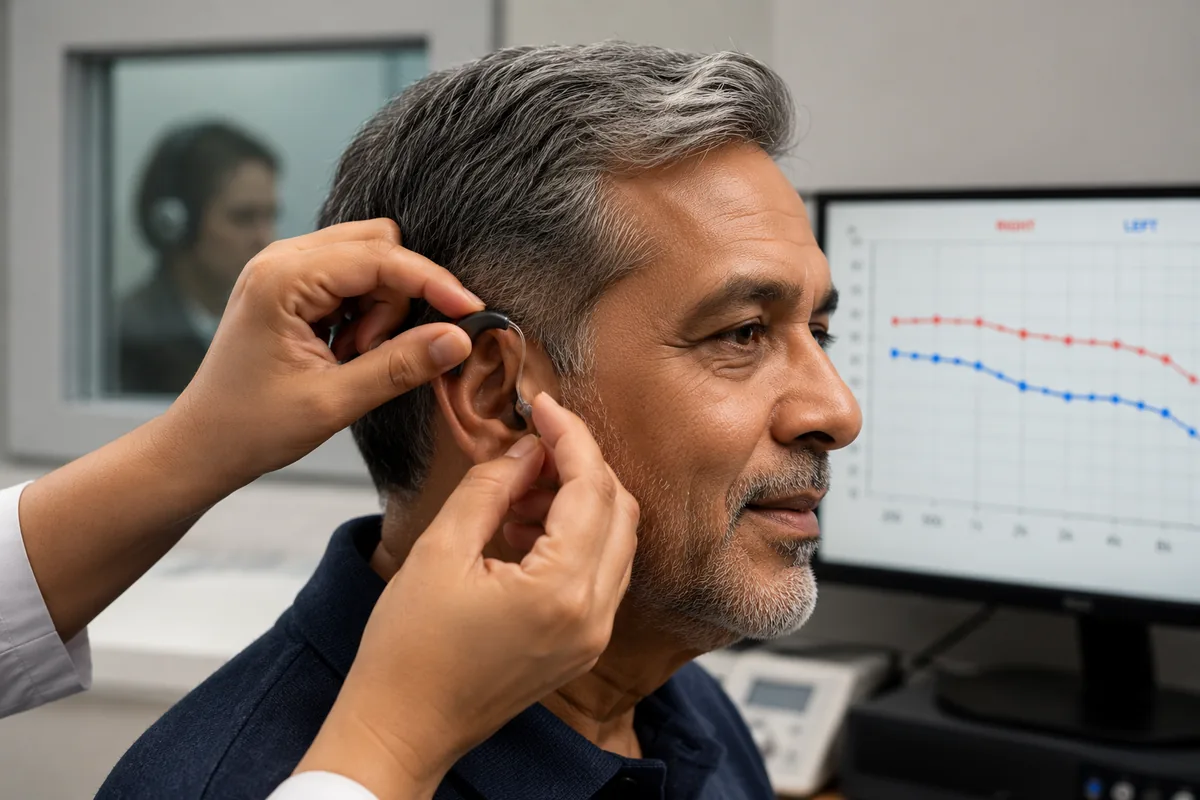
The audiogram is explained to you directly — which frequencies are affected, how that maps onto the speech sounds you are missing, and whether a hearing aid is likely to help.
Why an ENT assessment should come first
Some hearing loss is entirely correctable. Impacted wax, fluid behind the eardrum, a perforation or ossicular problems all reduce hearing — and all are treated rather than aided. Buying a device before an ENT examination risks paying for something that a five-minute procedure or an operation would have fixed properly.
An ENT assessment also identifies patterns that need investigation rather than amplification — notably hearing loss markedly worse in one ear, or sudden loss, which is a medical urgency. See ear and hearing treatment.
Types of hearing aids
| Style | Description | Best suited to |
|---|---|---|
| BTE — behind the ear | Body sits behind the ear, tube to an earmould | All degrees of loss including severe; easy to handle |
| RIC — receiver in canal | Slim body behind ear, tiny speaker in the canal | Mild to severe loss; discreet, natural sound — the common modern choice |
| ITE — in the ear | Custom shell filling the outer ear | Mild to moderately severe; simple to insert |
| CIC / IIC | Sits deep in the canal, nearly invisible | Mild to moderate loss; cosmetically discreet, smaller battery |
Modern devices are digital and programmable, with directional microphones, noise reduction, feedback cancellation, rechargeable batteries and Bluetooth streaming from phones and televisions on many models.
Devices available at the clinic
Vista ENT Clinic works with established German and Danish manufacturers, including Maico (Germany), Signia (Germany) and Widex (Denmark), across a range of technology levels and budgets.
The honest guidance on cost: higher technology levels mainly improve performance in difficult listening environments — noisy restaurants, group conversation, background traffic. If your life involves a lot of that, the upgrade earns its price. If you mostly listen at home one-to-one, a mid-range device may serve you just as well. That conversation happens before you commit.
Fitting and follow-up
- Assessment — ENT examination and full audiometry.
- Selection — discussing style, technology level and budget against your actual listening needs.
- Ear impression — taken where a custom mould or shell is required.
- Fitting and programming — the device is programmed to your specific audiogram, not set to a generic profile.
- Trial and fine-tuning — you use it in real life, then return for adjustment based on what actually happened.
- Ongoing review — periodic checks, reprogramming as hearing changes, cleaning and servicing.
Programming to the individual audiogram is what separates a fitted hearing aid from an amplifier bought online. A device that simply makes everything louder frequently makes speech harder to follow, which is why those purchases so often end up in a drawer.
Adjusting to hearing aids
The first two weeks feel strange for almost everyone. Your brain has adapted to reduced input over years, and sounds you had stopped noticing — paper rustling, your own footsteps, traffic — return all at once and feel disproportionately loud. Your own voice sounds odd.
This settles. Practical advice: start at home in quiet surroundings, build up wearing time gradually, practise with one person before tackling a group, and keep a note of specific situations that were difficult so they can be addressed at the follow-up. Persist through the first fortnight — most people who abandon hearing aids do so during exactly this period, just before it starts working.
For severe to profound hearing loss where aids no longer provide useful benefit, cochlear implant surgery may be the appropriate next step.