
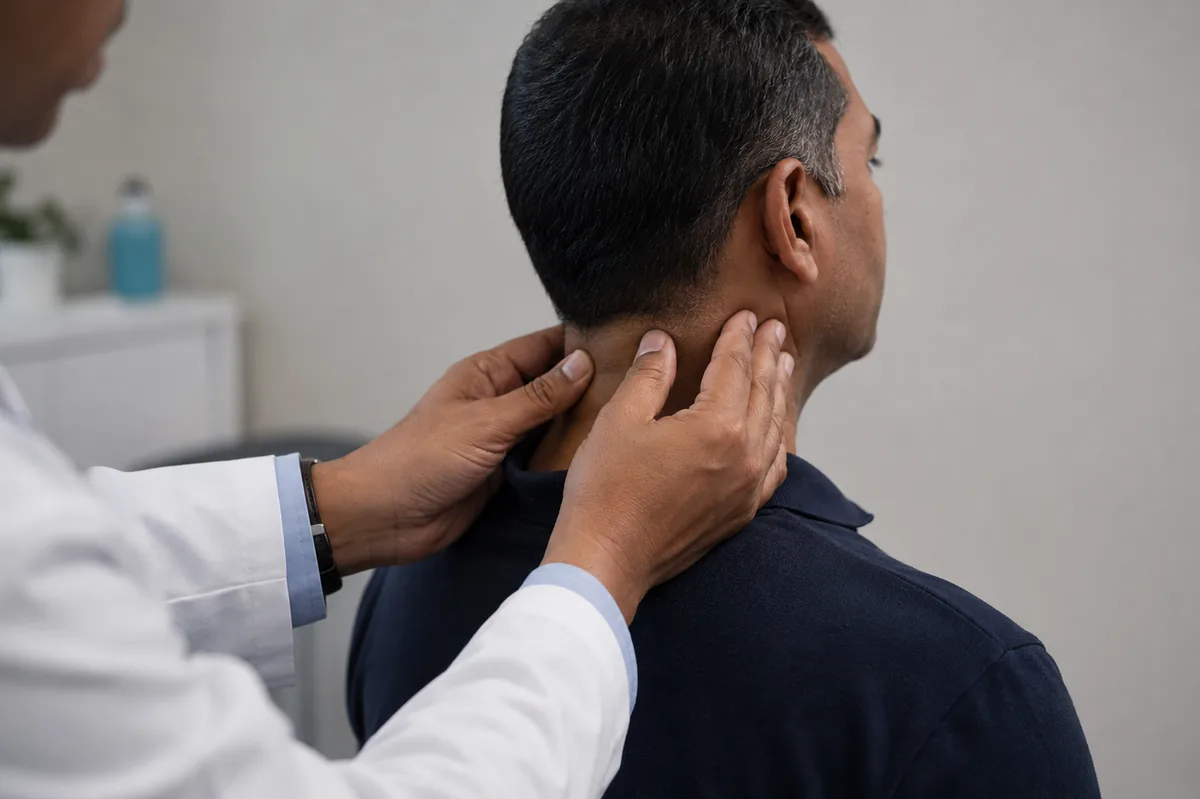
Head and neck conditions treated
Dr. Harsh Vardhan is a member of the Foundation of Head and Neck Oncology, and head & neck tumour surgery is among his declared areas of interest alongside endoscopic skull-base work.
The neck lump — and the three week rule
Lumps that appear during an infection and settle within two to three weeks are usually reactive lymph nodes and entirely normal. A lump that persists beyond three weeks, is painless, hard, fixed, or steadily enlarging needs assessment. Early diagnosis fundamentally changes outcomes in head and neck cancer.
Features that raise more concern: a hard, painless lump that does not move freely; enlargement over weeks; associated hoarseness, difficulty swallowing or one-sided ear pain with a normal ear; unexplained weight loss; and a history of tobacco or heavy alcohol use.
Reassuring features: recent onset with a sore throat or dental infection, tenderness, mobility, and steady reduction in size over a fortnight.
Thyroid surgery
The thyroid sits at the front of the neck and commonly develops nodules — the large majority benign. Surgery is considered when a nodule is suspicious on cytology, when a goitre is large enough to compress the windpipe or oesophagus, for overactive glands not controlled medically, and for confirmed thyroid cancer.
Assessment involves thyroid function blood tests, ultrasound of the gland and neck nodes, and FNAC of the nodule. Depending on findings, surgery may be a hemithyroidectomy (one lobe) or total thyroidectomy.
The critical structures are the recurrent laryngeal nerves supplying the vocal cords, and the parathyroid glands controlling calcium. Careful identification and preservation of both is the core surgical discipline here. Voice change and temporary low calcium are the risks discussed in detail beforehand.
Oral cavity and throat lesions
Mouth ulcers are common and nearly always harmless. The exception is important: an ulcer that has not healed within three weeks, particularly in someone who uses tobacco, gutkha, paan or areca nut, or drinks heavily.
Other features worth acting on are a white or red patch in the mouth that will not rub away, a lump on the tongue or inside the cheek, unexplained loose teeth, numbness of the lip or tongue, and persistent one-sided ear pain with a normal-looking ear — which is classic referred pain from the throat or tongue base.
Tobacco use in any form is the dominant risk factor for oral cancer in India, and the combination of tobacco and alcohol multiplies risk substantially. Early lesions are highly treatable; advanced ones are not, and the difference is often only a few months of delay.
Endoscopic nasal and skull base surgery
Some tumours arise in the nose and sinuses and extend towards the base of the skull. These were historically approached through external incisions on the face. Modern endoscopic skull base surgery reaches many of them entirely through the nostrils, using angled endoscopes and specialised instruments.
Dr. Vardhan's listed expertise includes endoscopic removal of nasal tumours such as inverted papilloma and juvenile nasopharyngeal angiofibroma. The advantages are no facial scars, less disruption of normal structures and generally faster recovery — though suitability depends entirely on the tumour's size, type and exact extent.
How a neck lump is investigated
- Examination of the lump and a full ENT examination, since neck nodes frequently reflect a primary lesion in the throat, tongue base or nasopharynx.
- Flexible endoscopy to inspect the nose, throat and larynx directly — often where the actual source is found.
- Ultrasound of the neck, defining the lump's nature and mapping other nodes.
- FNAC under ultrasound guidance where appropriate, providing cells for the pathologist.
- CT or MRI to map extent when malignancy is suspected or confirmed.
An open surgical biopsy of a neck node, done as the first step before proper workup, can complicate later definitive treatment if the node turns out to be metastatic cancer. The correct sequence is examination, endoscopy, imaging and needle cytology first. This ordering genuinely matters.
What surgery involves
Procedures range from excision of a benign cyst under general anaesthesia with an overnight stay, through thyroid and salivary gland surgery, to neck dissection for confirmed nodal disease.
Incisions are placed in natural skin creases of the neck wherever possible, so scars settle into existing lines. Where malignancy is confirmed, care is coordinated with oncology for radiotherapy or systemic treatment as required, and structured follow-up surveillance is arranged.
Consultation, endoscopy and FNAC take place at the Sector 82A clinic. Major surgery is performed at Fortis Hospital, Manesar. Related pages: parotid surgery and throat and voice care.